


This is lesson #16.
The whole Serviced Accommodation Training Guide is available here.
Lessons 12 to 15 covered Pathway A, rent to rent, where somebody else owns the building.
This lesson starts Pathway B, where you own the building. Running it day to day is pretty much the same. The big difference is how you pay for it, and what that money lets you do afterwards.
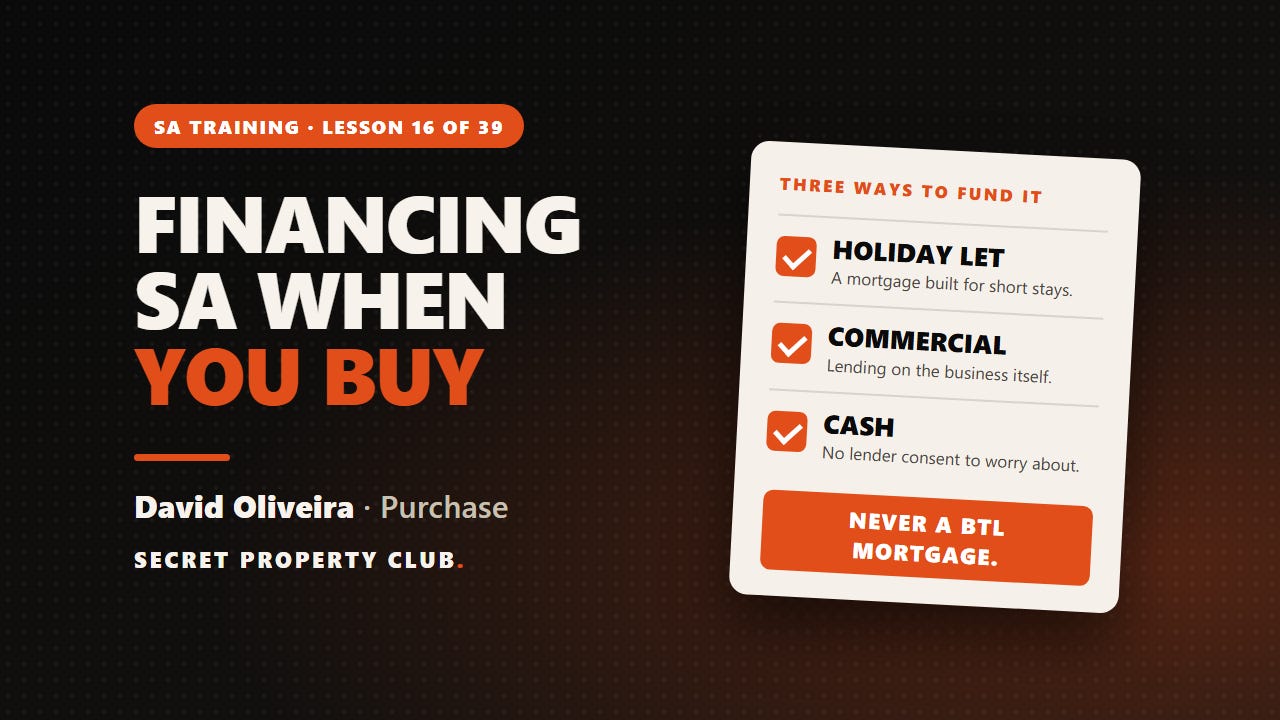
There are three ways to pay for a property you want to run as serviced accommodation. Don't just go for the cheapest rate. Go for the one that allows you to run it as SA.

The Buy To Let Mortgage Trap
A normal buy to let mortgage is written for letting to a residential tenant. In England that now means an assured periodic tenancy, because the Renters' Rights Act turned every AST into one on 1 May 2026. Short stays and holiday lets don't fit that. If you run serviced accommodation on a normal buy to let mortgage without the lender's written consent, you're breaking your mortgage conditions.
Some people do it anyway, because they think nobody checks. Sometimes nobody does. But the lender usually finds out at the worst time, when you remortgage, when you make an insurance claim, or when a neighbour complains. And it's not just a warning letter. The lender can call in the loan, and your insurer can refuse a claim because the property wasn't being used the way you told them.
So get it in writing before you complete. The mortgage has to allow the property to be used as SA.
Route #1 - A Holiday Let Mortgage
This is the mortgage made for SA. Holiday let and short term let mortgages are a different type of product, and lenders look at them differently from buy to let. Instead of one monthly rent figure, the lender usually looks at the expected income in the low, mid and high season, and applies its own cover ratio to that.
You'll have fewer lenders to choose from, you'll need a bigger deposit, and the rate is higher than a similar buy to let. That's the cost of doing it properly, and it's nearly always cheaper than getting caught out.
It also means the area research from lessons 9 and 10 has a second job. It tells you if the property will get booked, and it's also the evidence the lender looks at.
Route #2 - Commercial Or Semi-Commercial Lending
Commercial lending comes in when the property is run as a business rather than a single home let out. For example, several units in one building, a property with a commercial part, or properties held in a company.
The lender looks at it differently. A commercial lender looks at the business as much as the building, so your accounts, your track record and your forecasts matter much more than with a residential mortgage. Your first one is harder to get. Once you've got a trading history to show, it gets a lot easier.
Route #3 - Cash
With cash, there's no lender, so there's no consent to ask for, no cover ratio and no remortgage where the use comes up again. It's the simplest route and the quickest to complete, which helps a lot when you're up against other buyers.
The downside is that all your money sits in one property. Money tied up in one unit isn't spread across three, and SA income goes up and down with the seasons and can stop for reasons you can't control. If a cash property sits empty for a bad quarter, you carry all of that yourself, because there's no lender sharing the risk.
Cash usually isn't forever either. If you buy with cash, you'll probably want to refinance later, and then the question of whether the mortgage allows SA comes back. Think about it when you buy, not when you refinance.
How To Choose Between Them
None of the three is best for everyone. It depends on what's holding you back, whether that's money, time or which lenders will lend to you. Below, I share how I'd choose between them, and the one check I'd do before committing to any of them. Premium members can read it, along with the full archive and the rest of the Serviced Accommodation course.
This is based on standard UK buy to let and holiday let lending conditions. Lender terms change often, so check the current criteria with a broker before you commit.
That's the overview. Below is what I'd do, the order I'd do it in, and the one check I'd make before committing to any route.
Premium members only. Upgrade here to read the rest and unlock the whole SA course.
