

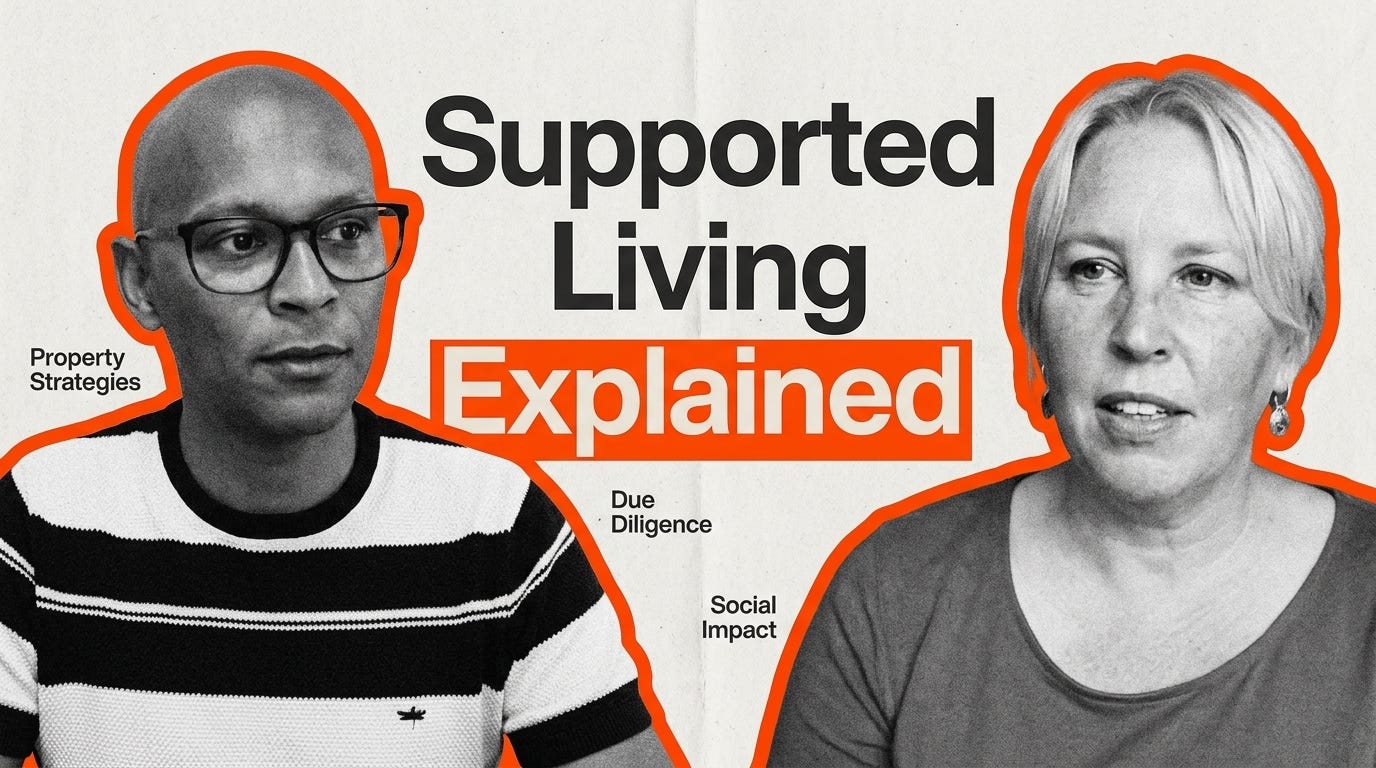
I sat down with Lisa Brown, founder of the Supported Living Property Network and host of the Supported Living Property Podcast, to go beyond the “guaranteed rent” pitch most of us have heard about supported living.
Lisa came into property from a nursing career, not a property one, and now both develops supported living properties herself and connects investors to the organisations that lease them.

What Supported Living Actually Is
Supported living sits under the social housing umbrella, but it is specifically for tenants with a support need, not tenants who are there for economic reasons alone.
Some tenants need only a few hours a week, such as help registering with a GP or applying for benefits after a period of homelessness. Others need two or three support workers around them twenty-four hours a day to live independently.
Every town and city has people who fall somewhere in that range, including people with learning disabilities, people who have experienced homelessness or domestic abuse, and veterans rehabilitating back into independent life.
What Type Of Property Actually Works
There is no single supported living property type.
The organisations looking to lease include care companies, housing associations, small charities and community interest companies, and they are all looking for different things.
Some want large HMOs, though that is rarer than people assume. Most want good quality, fully compliant properties:
Small HMOs
Bungalows
Small blocks of flats.
Standard houses.
Tired properties don’t get repurposed into supported living.
The property has to be compliant and well presented from day one.
Why “Guaranteed Rent” Is The Wrong Phrase
Lisa will not use the term guaranteed rent. Nobody is actually guaranteeing it. What happens instead is that an organisation signs a lease with you, not an AST, and is contractually obliged to pay monthly rent for the length of that lease, regardless of whether the property is occupied at any given time.
She describes it as the closest the residential sector gets to hands-free investing, closer in structure to a commercial lease than a standard buy-to-let.
Maintenance responsibility depends on the specific lease, but providers generally take on a significant share of compliance, repairs and maintenance.
What Income To Actually Expect
Most of the providers Lisa works with pay market rent or above.
HMOs where the provider takes on all bills, maintenance and voids tend to come in below market rent, though she says most landlords are still net better off once those costs are accounted for.
Some organisations, including large outsourcers like Serco and Mears, pay Local Housing Allowance, sometimes LHA plus or minus ten percent depending on how they are funded.
Lisa doesn’t work with those two and does not rate their leases, and advised that you can approach them directly through their own websites. There is no need to pay an introducer several thousand pounds for that access.
Above-market rent has to be justified, usually by genuine adaptation such as widened doorways or a wet room, since housing benefit teams are scrutinising these rents far more closely than they used to.
Lease Length And Renewal
Most of Lisa’s providers sign around a five-year lease.
Ten-year leases exist, fifteen-year leases are rare and situational, and some organisations with less certain funding will only commit to two years, or as little as six months for a crisis placement.
At the end of a lease, the property should come back to you in the condition set out in the agreement.
Renewal is common when things have gone well, and for tenants with more complex or lifelong support needs, the intention from day one is often that the property becomes a permanent home.
The Due Diligence That Actually Matters
Lisa’s advice was to treat the provider like a business partner, not a tenant.
Look at how they are funded, and look at their history:
Was the organisation set up purely to make money in a growing market, or does it come from someone with a genuine background in the sector who saw a gap and built something to fix it?
You are trusting this organisation to stand behind a multi-year lease, so understanding where their income actually comes from really matters.
A Market That Is Getting More Selective
Interest in supported living has grown fast, and with it has come a wave of investors motivated purely by yield, and a wave of self-appointed introducers charging landlords for contacts that are freely available online.
Lisa has seen providers get burned by both, and the result is that providers are now noticeably more discerning about who they lease from than they were a few years ago.
Her read on the next five to ten years is more demand, not less, but a market that increasingly rewards landlords who take it seriously rather than those treating it as easy money.
Where To Start
Lisa’s own guide to finding providers is free to download from her website, and her Property Match Service lets you list a property at no cost so providers can find you directly.
Her Supported Living Property Network is the lowest-cost way to go deeper. It’s just £35 a month plus VAT, with courses, monthly training, monthly community events and an annual conference where investors and providers are in the same room.
She also takes on a small number of one-to-one mentoring clients directly.
If you have a property sitting empty or underperforming as a standard let, this is worth a proper look.
Thank you to Lisa Brown for being so direct about the mechanics of a model that gets sold on hype far too often.
Want More Than The Free Articles?
The paid membership gets you past the newsletter.
That means:
Private coaching sessions with David and Heidi.
The full course archive, including the Serviced Accommodation training series.
Deal-analysis tools.
Direct access to the team when you’re working through a real decision, not just reading about one.
If you’re serious about doing this rather than just following along, upgrade to a paid Secret Property Club membership.


